A new version is available.

We've updated our website. Please click the button to download the new version.

Download now

Agriculture Switzerland (Swiss Stories 2015, by Markus Bühler) - Swiss Press Award
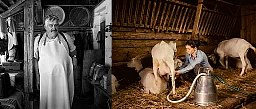
Photo / Swiss Stories
2015

Agriculture Switzerland

Markus Bühler

Swiss Agriculture: Contemporary photographers generally steer clear of Swiss agriculture, and when it does come into focus, it is often done so ironically or skewedly. The fear of being relegated to the anachronistic corner as a photographer seems too great. XY is an exception. His photographs depict local farmers beyond idealization and ideological critique. The image of agriculture in Switzerland is ambivalent and polarized. There is the conservative notion of Switzerland as a nation of freedom-loving, independent farmers. The battle for cultivation, the electoral plan, autarky, the Rütli, the special case, the SVP, Albert Anker, the Alpine Cattle Drive, the Landsgemeinde... In contrast, local agriculture is often ridiculed by the young, educated, urban population. Tourist attraction, folklore, subsidies, romanticization, inefficiency, mythologization, atavism... This dual face is also evident in photography. On the one hand, there is the agrarian, "natural" Switzerland, as portrayed on postcards, in illustrated books, and by tourism associations. On the other hand, rural Switzerland rarely appears in contemporary, "serious" photography, and when it does, it is refracted, ironized, distorted, deconstructed. What is special, indeed unique, about Markus Bühler's images is that he attempts to take a stance beyond these stereotypes. He has undertaken nothing less than an inventory of Swiss agriculture, and he approaches this immense task, which has occupied him for years, with the eye of a researcher. "I want to know what it's like," he says quite simply. It's neither about stylization nor questioning, but about bringing it closer. XY developed this precise and respectful approach through his intensive study of Greenland. The essence of these studies was the impressive illustrated book "Inuit." Now he applies his "ethnological" approach to the world of local farmers, so close yet so distant. His perspective has something subversive about it, precisely because he doesn't want to be subversive. Does he want to glorify the farmer with the scarf on his head, which makes him look a bit like Tell, as a national hero? Does he want to ridicule him? Neither. The next image, with the hay bale, makes it clear what the headgear means. But as a viewer, you find yourself involuntarily wanting to push the photographer into one corner or the other, that of the original Swiss patriot or that of the caricaturist. XY's images defy these categories.

AS Verlag/Landwirtschaft Scheiz

Photo / Swiss Stories
2015

Markus Bühler

Swiss Agriculture: Contemporary photographers generally steer clear of Swiss agriculture, and when it does come into focus, it is often done so ironically or skewedly. The fear of being relegated to the anachronistic corner as a photographer seems too great. XY is an exception. His photographs depict local farmers beyond idealization and ideological critique. The image of agriculture in Switzerland is ambivalent and polarized. There is the conservative notion of Switzerland as a nation of freedom-loving, independent farmers. The battle for cultivation, the electoral plan, autarky, the Rütli, the special case, the SVP, Albert Anker, the Alpine Cattle Drive, the Landsgemeinde... In contrast, local agriculture is often ridiculed by the young, educated, urban population. Tourist attraction, folklore, subsidies, romanticization, inefficiency, mythologization, atavism... This dual face is also evident in photography. On the one hand, there is the agrarian, "natural" Switzerland, as portrayed on postcards, in illustrated books, and by tourism associations. On the other hand, rural Switzerland rarely appears in contemporary, "serious" photography, and when it does, it is refracted, ironized, distorted, deconstructed. What is special, indeed unique, about Markus Bühler's images is that he attempts to take a stance beyond these stereotypes. He has undertaken nothing less than an inventory of Swiss agriculture, and he approaches this immense task, which has occupied him for years, with the eye of a researcher. "I want to know what it's like," he says quite simply. It's neither about stylization nor questioning, but about bringing it closer. XY developed this precise and respectful approach through his intensive study of Greenland. The essence of these studies was the impressive illustrated book "Inuit." Now he applies his "ethnological" approach to the world of local farmers, so close yet so distant. His perspective has something subversive about it, precisely because he doesn't want to be subversive. Does he want to glorify the farmer with the scarf on his head, which makes him look a bit like Tell, as a national hero? Does he want to ridicule him? Neither. The next image, with the hay bale, makes it clear what the headgear means. But as a viewer, you find yourself involuntarily wanting to push the photographer into one corner or the other, that of the original Swiss patriot or that of the caricaturist. XY's images defy these categories.

Author