A new version is available.

We've updated our website. Please click the button to download the new version.

Download now

Luchalibre in El Alto (Swiss Stories 2015, by Desiree Good) - Swiss Press Award
Luchalibre_01
Luchalibre_01
Photo / Swiss Stories
2015

Luchalibre in El Alto

Desiree Good

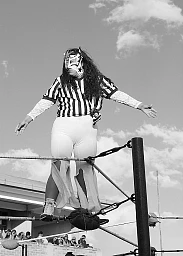
Along with football, wrestling is essential to the people of Bolivia and closely linked to national pride. This popular sport is called Lucha Libre (freestyle wrestling) and is usually staged and choreographed. Many of the fighters are female. Today, the fights are mainly shown in El Alto, the country's second-largest city. El Alto lies at an altitude of 4,000 meters above sea level and contrasts sharply with the much more affluent La Paz, whose cityscape is partly modern, partly colonial. I find it fascinating how wrestling becomes an outlet. Moral concepts are subverted with a great deal of Negro humor. For example, the referee supports the bad guy, men fight women, etc. Bolivians have transformed Lucha Libre, which originated in Mexico, into their own cultural folk theater. Good and evil, death and clown, as well as "Batman" and the "Cholita" (an indigenous woman in traditional Spanish costume) face off. For three months, I photographed a young, twenty-three-year-old fighter named Lady in her environment. She dropped out of college and competes four times a week with her fellow fighters. Her younger boyfriend has also started fighting. Against her parents' wishes, she pursues the goal of becoming an internationally successful fighter. 2014 The work was published in the Tagesanzeiger magazine and exhibited at the Photobastei. Supported by the Globetrotter World Photo program with sponsors Nikon and Globetrotter.



Tagesanzeiger Magazin

Photo / Swiss Stories
2015

Desiree Good

Along with football, wrestling is essential to the people of Bolivia and closely linked to national pride. This popular sport is called Lucha Libre (freestyle wrestling) and is usually staged and choreographed. Many of the fighters are female. Today, the fights are mainly shown in El Alto, the country's second-largest city. El Alto lies at an altitude of 4,000 meters above sea level and contrasts sharply with the much more affluent La Paz, whose cityscape is partly modern, partly colonial. I find it fascinating how wrestling becomes an outlet. Moral concepts are subverted with a great deal of Negro humor. For example, the referee supports the bad guy, men fight women, etc. Bolivians have transformed Lucha Libre, which originated in Mexico, into their own cultural folk theater. Good and evil, death and clown, as well as "Batman" and the "Cholita" (an indigenous woman in traditional Spanish costume) face off. For three months, I photographed a young, twenty-three-year-old fighter named Lady in her environment. She dropped out of college and competes four times a week with her fellow fighters. Her younger boyfriend has also started fighting. Against her parents' wishes, she pursues the goal of becoming an internationally successful fighter. 2014 The work was published in the Tagesanzeiger magazine and exhibited at the Photobastei. Supported by the Globetrotter World Photo program with sponsors Nikon and Globetrotter.


Author